

What is the customer lifecycle?
Small companies that work with heart, attitude and purpose are faced with a balancing act: they want to sell – but not persuade. They want to grow – but not at the expense of people or the environment. They want to be visible – but not shout about the market. This is exactly what the Customer Lifecycle (in German: customer life cycle) is a valuable model. Not as a marketing ploy, but as a relationship compass. From initial attention to loyal fan – This is how sustainable brands accompany their customers with attitude instead of pressure. The customer lifecycle describes the entire journey that a person takes with your company – from the first contact to repurchase (and ideally beyond).
Unlike the Customer Journey, The lifecycle starts right there, from the moment a customer makes a purchase. This is ideal for conscious brands: instead of aggressive conversion strategies, this approach focusses on sustainable customer loyalty. This is a particularly valuable model for sensitive founders, vegan brands and social enterprises.
There are 5 phases:
-
Phases 1–3 often bring the fastest visible success.
-
Phase 4 shows how sustainable your business really is.
All steps together form the Customer Experience – is the overall experience your customers have with your brand. Numerous touchpoints, i.e. points of contact between the customer and the brand, are created along the way.
These touchpoints can be roughly divided into two categories:
-
Managed touchpointsContact points targeted by the company, such as online adverts, newsletters, product pages or POS displays.
-
Earned touchpointsuncontrollable but enormously influential touchpoints such as reviews, recommendations, social media mentions or viral trends from the community.
In addition, a distinction is often made between digital and physical touchpoints – from the Instagram ad to the product packaging to the customer dialogue at the trade fair stand. Both types are crucial for brand perception – and should be strategically coordinated.
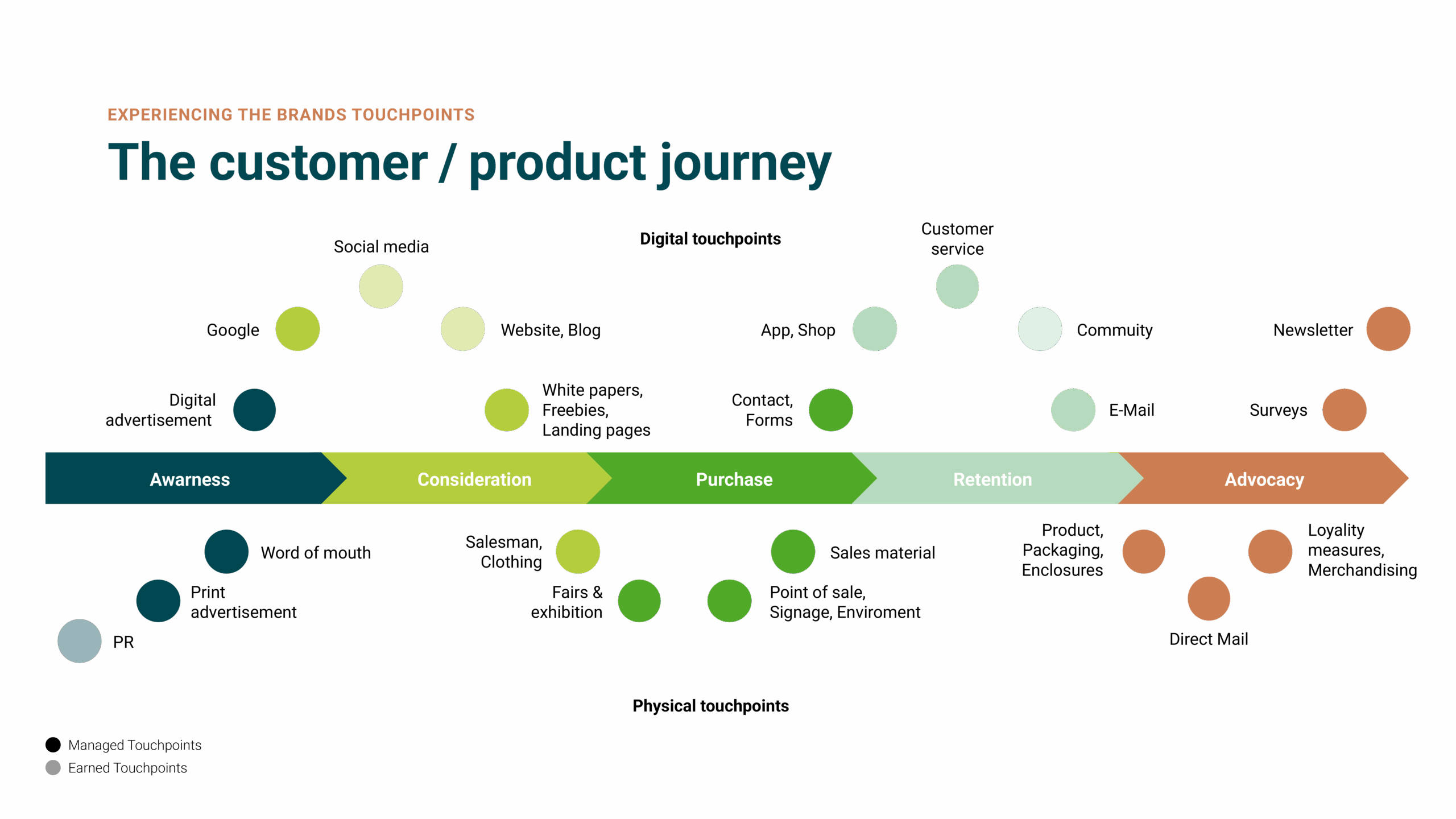
1. attention (awareness) – Consciousness
In this phase, a person encounters your – brand for the first time, be it through an Instagram post, a recommendation, a Google search or a visit to a trade fair. Now one thing counts above all else: Relevance. Your content must address a real need – honest, informative, likeable. Users scroll quickly and make decisions intuitively. This makes it all the more important to have a concise presence that inspires trust.
Around 90 % of users read online reviews before they engage with a brand. That shows: Your existing customers also have an influence in the awareness phase. Use authentic testimonials, strong SEO content and social reach. Make sure you use clear language and a consistent design – it's your digital handshake.
What does your target group need now?
-
Orientation in the chaos of offers
-
Trust that you will really understand
-
No empty marketing promises, but substance
Here you should shine with:
- Divi websites, that create clarity, not confusion.
-
Storytelling, that shows your attitude – not your sales targets.
-
Social media content, who doesn't want to sell himself, but touches.
-
Blog articles with real added value (no SEO grits with 27 keywords in 400 words)
-
Google & facebook Ads, that don't look like clickbait
- Target group-orientated corporate design for a clear line
But be careful: At this stage, you don't want to come across as a puffery, but as someone who is solving a real problem. Informative, honest, helpful – is not a polished sales pitch. Your buyer persona has a need, you (hopefully) have the solution.
2nd comparison phase (Consideration) – Consideration
Now it's time to get down to business: interested parties compare offers, check prices and click through product details. Perhaps your product is already in a wish list or the shopping basket has been filled – but not yet purchased. Now is the time to Building trust and Show competence. Your website should have a logical structure, load quickly and clearly display relevant information.
With real Case Studies, product reviews or, for example, a checklist such as „What to look out for when buying“, you strengthen your position in the mind of the buyer. This determines whether your company is perceived as professional and likeable – or as interchangeable.
What do they need now?
-
Evidence. Clarity. Real insights.
-
No high gloss, but approachability
-
The feeling: „They've thought it through.“
What works here:
-
Clearly structured information on your website (product descriptions, references, value catalogues)
-
Testimonials, case studies, real people instead of stock photos
-
Transparency: Where do the materials come from? Who does the job?
-
CD manuals & visual clarity, that show: „We know who we are.“
- Product pages, that answer all questions before they are asked
Practical tip: A „Have you forgotten something?“ reminder by email is often the final nudge towards a purchase. (It also works in real life, only more subtly).
3rd purchase phase (Purchase) – Conversion
The decision has been made – Now nothing can go wrong. A cumbersome checkout, missing payment methods or a confusing shopping basket can lead to cancellation. Make the Purchase process as simple as possibleGuest orders, clear discount information, helpful hints and a barrier-free process are all part of this.
The same applies here: communicate smartly! For example, use notices such as „Only 3 items left in stock“ or „€10 discount for newsletter subscriptions“. Make sure that customers are not overwhelmed by pop-ups – Authenticity comes first.
What do they need?
-
Clarity. Overview. Options.
-
A process that feels easy – not like an obstacle course
-
A little appreciation is also welcome
Don't mess this up:
-
WooCommerce Shops, that not only work, but also have a guided effect
-
Mobile-optimised design, especially for sensitive users who shop on the move
-
Indications of sustainable benefits (e.g. climate-neutral shipping, plastic-free packaging)
-
Newsletter incentives, but not too pushy: „If you like, stay in touch with us.“
-
Clear checkout process No pitfalls with all common payment methods (incl. Klarna, Apple Pay & Co.) and a clearly visible discount code field
-
Guest order possible? Yes please!
- Standardised product images in XXL and with zoom
Bonus: Offer an optional subscription model or club memberships – this creates loyalty and recurring revenue.
4. product experience (retention) – Retention
Now the product arrives at – and this moment decides whether a one-off purchase turns into a long-term relationship. Packaging, shipping information, additional materials: everything counts. Is the Parcel lovingly and sustainably packed? Is there a nice message, a small gift or a discount for the next order? These gestures turn a delivery into an experience.
Customer service also plays a key role now. Are queries answered quickly and in a friendly manner? Are returns uncomplicated? All of this shows: You take your customers seriously – and this is rewarded.
What do customers need now?
-
Orientation (parcel information, returns, contact options)
-
The feeling of not being alone with the product
-
And in the best case: small, loving surprises
What they really appreciate here:
-
Automated, but humanly written emailsShipping, Thank you, Welcome, Updates + Tracking number
-
Short instructions or tutorials, how the product is ideally utilised
-
Give-aways or discount codes, that feel like appreciation, not like a loss leader (sticker, discount card, love letter)
-
Sustainable packaging, the posture shows – no plastic cringe
- Return form directly in the parcel (please NO printout necessary!)
This is where the stories that your customers tell – or not are created.
5. brand loyalty (advocacy) – Fans
The customer was satisfied? Then now is your chance to retain them in the long term. Surprise them with promotions for existing customers, remind them of products in their shopping basket with smart emails or offer exclusive content for club members. Particularly effective: Personalised communication – e.g. a birthday greeting or a seasonal discount campaign.
Make sure you don't come across as overbearing in this phase either. People can sense whether you are really building a relationship – or whether you just want to force the next purchase. Fans don't stay because of discounts, but because of emotions.
What do your customers want?
-
Not to be forgotten
-
Inspiring impulses
-
Appreciation for their loyalty
What seems like a love letter:
-
Personalised newsletter, not just „Hello {first name}“, but really relevant
-
Reactivate inactive contacts with heart, not pressure („You haven't been here for a long time. Look what we've changed.“)
-
Birthday emails, holiday greetings, promotions for regular customers
-
Social media formats, in which customers themselves appear (e.g. reposts, community campaigns, feedback highlights)
-
Long-term content strategy, which is not sold, but accompanied
And the best thing is: if your product is really convincing, your customers will voluntarily take over the marketing for you –. Whether via TikTok, Insta, reviews or in real life: Enthusiastic people talk.
The lifecycle is not a tool – but an attitude
And that's exactly why it goes so well with sustainable entrepreneurs, sing-driven projects, vegan labels, creative lone fighters and all those who prefer honest growth to aggressive scaling.
Those who understand what makes customers tick, when they need attention and where they drop off will win in the long term. Not with discount battles. But with well thought-out, human touchpoints.
The lifecycle is a relationship model. If you realise that your brand doesn't stand for products, but for values and attitude, then you will automatically attract people who are looking for exactly that. Not louder, but clearer. Not broader, but deeper.
We at 2bu design help you to understand each phase of this lifecycle Visual, strategic and empathetic – with clear communication, well thought-out design and a holistic brand identity that works.
What we can do for you, for example:
- Strategy consulting for sensitive founders & sustainable brands
-
Emotional, well thought-out Corporate Design incl. CD manuals
-
Social Media Marketing, that communicates honestly – does not persuade
-
SEO-strong Divi websites with heart and structure
-
Customised WooCommerce shops, who sell without being annoying
- Newsletter campaigns and lifecycle email routes

 German
  English